
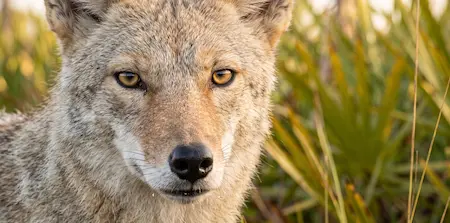
Understanding Coyotes in Florida
Coyotes are one of North America’s most versatile and adaptable mammals. Once strictly a western species, coyotes began migrating east and arrived in north Florida in the 1970s. Today, they are recognized as a naturalized species present across all 67 Florida counties. Whether roaming deep forests, rural farmlands, or suburban neighborhoods, these clever canids have successfully made the Sunshine State their home.
Physical Characteristics and Identification
At first glance, a coyote might look like a medium-sized domestic dog, but several distinct traits set them apart:
- Size and Build: Coyotes generally weigh between 20 and 30 pounds, with males being slightly larger than females.
- Coloring: Their pelts are typically a mixture of grayish-brown, though black coyotes with a white patch of chest hair are occasionally spotted.
- Distinct Features: They have pointed ears, a narrow muzzle, and a bushy tail.
- Movement and Tracks: Unlike domestic dogs whose tails often curl upward or wag loosely, coyotes run with their tails extended behind them at "half-mast." Their foot tracks are noticeably narrower and more elongated than typical dog tracks.
The Most Vocal Mammal in North America
If you have ever heard a chorus of wild vocalization at dusk, you have likely listened to coyotes. They hold the title of the most vocal of all North American mammals. In fact, their scientific name, Canis latrans, translates directly to "barking dog."
Coyotes use a sophisticated repertoire of at least 11 distinct vocalizations to communicate with one another:
- Lone Howls: The classic, iconic sound of the coyote, used primarily to announce the presence of an individual separated from its pack.
- Group Howls: Used as collective responses to lone howls or group calls across territories.
- Group Yip Howls: Emitted when two or more pack members reunite, serving as the climax of a complex greeting ritual.
- The "Wow-Oo-Wow": A specialized sound often described by researchers as a warm "greeting song."
Territory and Adaptable Diet
Coyotes are fiercely territorial animals. A resident breeding pair establishes a home territory that is shared exclusively with their immediate family group. Depending on local food availability and landscape conditions, a territory range can span anywhere from 1,500 to 12,000 acres.
Part of what makes coyotes so successful in Florida is their opportunistic omnivorous diet. They are far from picky eaters and will feed on:
- Small mammals like rats, mice, and rabbits
- Birds, deer, and livestock
- Fruits, plants, and insects
- Virtually any type of carrion
- Human-related food sources, including unsecured trash and outdoor pet food
Reproduction and Family Life
Coyotes have a highly structured family life. Young coyotes can breed as early as 10 months old, with breeding occurring once a year in late winter.
- Gestation: Following a 63-day gestation period, females give birth to a litter of 4 to 6 pups.
- Denning: Dens are usually located in natural sheltered spots, such as hollow logs, dense brush piles, or excavated ground burrows.
- Development: Pups first emerge from the safety of the den around 3 weeks of age. Both parents contribute to raising the young, and parental care continues until the offspring reach independence at 9 months.
Coyotes are a natural and permanent part of Florida's ecosystem. Understanding their behavior, vocalizations, and habits allows us to appreciate their role in nature while promoting safe coexistence.
Florida Fish and Wildlife Conservation Commission information on Coyotes.