

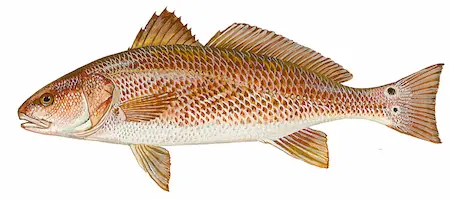
Freshwater fisheries biologists working on the St. Johns River recently made an exciting discovery: while traveling upriver, they encountered a variety of saltwater fish species, including the iconic Red Drum (Sciaenops ocellatus). Although Red Drum are primarily native to coastal marine waters, in winter they frequently move into estuarine environments, seagrass beds, muddy bottoms, spring-fed creeks, and oyster reefs. There, they use their powerful pharyngeal teeth to crush hard-shelled prey like oysters and crabs.
Visually, Red Drum are easily recognized by their large scales and striking copper-bronze body that gradually fades to a lighter white belly. Their most distinctive signature is a large, dark, ocellated spot located at the base of the tail. While a single spot on each side is typical, it is not uncommon to find individuals with multiple spots or, on rare occasions, no spot at all. This unique spot pattern serves as a natural defense mechanism, mimicking an eye to confuse potential predators about which direction the fish is facing.
Juvenile redfish grow quickly in nutrient-rich estuaries, reaching sexual maturity around age 4 when they average roughly 30 inches in length. Their annual spawning season spans from August through December, during which prodigious adult females can produce tens of millions of eggs per season. Red Drum earn their name from the unique drumming sound males produce during courtship by contracting specialized sonic muscles against their swim bladder.
To learn more about the biology and conservation of Red Drum, visit the official profile on the Florida Fish and Wildlife Conservation Commission website.
Key Characteristics and Identification
Red Drum, commonly referred to as redfish, channel bass, or spottail bass, possess distinct biological traits that set them apart from other drum species:
- Tail Spotting: One or more prominent dark spots at the base of the tail fin (though rare individuals lack them entirely).
- Jaw Structure: Unlike their relative the Black Drum, Red Drum completely lack chin barbels on their lower jaw.
- Scales & Dentition: Coarse, large scales along the body paired with heavy pharyngeal throat teeth designed to crush oysters and crustacean shells.
- Maximum Size: Can reach lengths of up to 61 inches and weigh over 50 pounds.
Similar Species Note: The Black Drum (Pogonias cromis) looks similar but features noticeable chin barbels and lacks the distinctive tail spot found on the Red Drum.
Habitat and Seasonal Movements
Red Drum are highly adaptable in their habitat choices throughout their life cycle. Young juveniles reside in shallow backwater estuaries, tidal creeks, and salt marshes where food is abundant and protection from larger predators is available. As they mature into sub-adults, they move freely into bays, intracoastal waterways, and nearshore waters. During cooler winter months or extended dry periods, adult and sub-adult Red Drum often venture farther upriver into brackish or spring-fed freshwater systems like the St. Johns River in search of stable water temperatures and active prey.
Diet and Feeding Behavior
Red Drum are opportunistic bottom feeders with a varied diet that changes as they grow. Juveniles feed primarily on small crustaceans, shrimp, and marine worms. Adults consume larger prey, including blue crabs, mud crabs, mullet, pinfish, and killifish (mud minnows). When foraging over shallow grass flats, Red Drum exhibit a behavior known as "tailing"—pointing their heads downward to dig prey out of the sediment while their tail fins break the surface of the water.
Angling Tips, Highlights, and Regulations
State Record Highlight: Florida’s official state record Red Drum was an impressive 52 lb 5 oz specimen caught near Cocoa in 1996.
Fishing Techniques: Red Drum are widely celebrated as one of Florida’s most popular inshore game fish. Effective methods include floating live shrimp or mud minnows under popping corks over shallow flats, casting soft-plastic jigs around structure, or working gold spoons and topwater plugs across grass edges.
Conservation & Management: Because Red Drum are vital to Florida's coastal ecosystems and recreational economy, harvest limits and bag restrictions are strictly regulated by region. Check current FWC Recreational Regulations before heading out on the water.