
The Resilient Fire Ant: A Biological Marvel and Invasive Force
Fire ants are fascinating creatures from a biological and ecological perspective. Known scientifically as Solenopsis invicta, these insects are much more than just a backyard nuisance. They represent a complex social structure and an evolutionary success story that has allowed them to colonize vast territories across the globe, particularly in the southern United States.
At the heart of their success is their unique social organization. Unlike many ant species, fire ants frequently establish colonies with multiple queens—a rare trait that allows populations to rebound quickly and grow at an exponential rate. A single queen is a biological powerhouse, capable of laying hundreds or even thousands of eggs in just twenty-four hours.
Anatomy and Behavior
Physically, fire ants are distinguished by their reddish-brown coloration and a body divided into three main segments: the head, thorax, and abdomen. Their six legs are attached to a short, sturdy thorax, which provides the leverage needed for rapid movement. While worker ants are typically only 1/8 inch in size, the reproductive members—queens and males—are slightly larger. The workers live for several months, while a queen can reign over her colony for several years.
Fire ants are famously aggressive. They are fiercely territorial and will defend their nests vigorously. When a threat is perceived, they swarm in seconds, injecting a potent venom through their stings. This venom causes a distinctive burning sensation and often results in itchy, pus-filled blisters. For many, these encounters are painful; for some, the allergic reactions can be severe or even life-threatening.
Survival Tactics and Ecological Impact
Perhaps their most impressive feat is their ability to survive floods. By linking their bodies together, fire ants form living rafts that float on the water's surface, protecting the queen and larvae until they reach dry land. Once established on new ground, they act as omnivorous scavengers, consuming plants, small animals, and other insects to satisfy their opportunistic diet.
However, this resilience comes at a cost to the environment. As invasive pests, they outcompete native species and disrupt local ecosystems. Their complex mounds—found both above and underground—can damage agricultural equipment and alter soil structures. Controlling them is a constant challenge. While natural predators like parasitic phorid flies and nematode worms are used in ecological management, severe infestations often require targeted chemical intervention.
Quick Facts
- Scientific Name: Solenopsis invicta.
- Diet: Omnivorous scavengers (plants, insects, and small animals).
- Lifespan: Workers live months; Queens live years.
- Defensive Tool: Venomous sting causing burning blisters.
Highlights
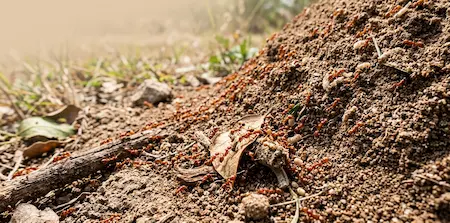
- Architectural Mounds: They build complex nests in loose soil that can span deep underground.
- Aerial Mating: Males and females engage in a unique mid-air ritual; the male dies shortly after, and the female starts a new colony.
- Living Rafts: Their ability to link bodies to survive floods is one of nature's most effective survival strategies.