
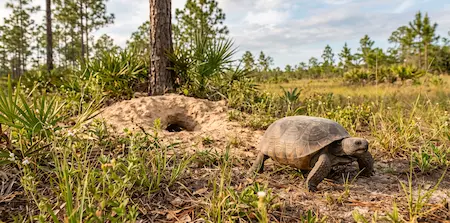
Florida’s Gentle Bulldozer: Meet the Gopher Tortoise
If you hike through Florida’s dry pine flatwoods, scrubby pastures, or coastal dunes, you will likely encounter an unassuming mound of light-colored sand. Beside it sits a half-moon opening leading underground. Meet the gopher tortoise (Gopherus polyphemus), Florida’s ancient, land-dwelling engineer.
Nature’s Ultimate Keystone Landlord
Gopher tortoises are classified as a keystone species—an organism whose presence anchors an entire ecological community. Their shovel-like forelimbs allow them to dig massive burrows measuring an average of 15 feet long and 6.5 feet deep.
These underground tunnels maintain steady temperatures year-round, creating a vital refuge from summer heat, winter freezes, and wildfires. More than 350 species share these shelters, including:
- Eastern indigo snakes
- Florida mice
- Gopher frogs
- Burrowing owls
Without the tortoise digging the foundations, hundreds of native wildlife species would lose their primary protection against the elements and predators.
Quick Facts
| Attribute | Detail |
| Lifespan | 40 to 60+ years in the wild (over 80 in captivity) |
| Diet | Herbivore (grasses, broadleaf weeds, berries, prickly pear) |
| Conservation Status | State-threatened in Florida; protected by law |
| Burrow Depth | Typically 6–10 feet deep, up to 40+ feet long |
| Top Superpower | Gets almost all needed hydration directly from its food |
Why They Need Protection
Gopher tortoises prefer well-drained, sandy upland soils with plenty of sunlight—the exact same terrain coveted by real estate developers. As a result, habitat loss and fragmentation remain their biggest threats, alongside vehicle strikes and road collisions.
In Florida, both the tortoise and its burrow are legally protected. It is illegal to touch, harass, capture, or relocate them without a permit from the Florida Fish and Wildlife Conservation Commission (FWC).
Tips for Coexisting with Gopher Tortoises
- Look, don’t move: If you spot one crossing a neighborhood road, you may carefully lift and carry it across in the exact direction it was already heading. Never take one to a different location or drop it into a pond—they cannot swim.
- Keep pets leashed: Domestic dogs are a major threat to juvenile tortoises whose shells take years to fully harden.
- Plant native flora: Wiregrass, wild blueberries, and prickly pear cactus provide natural foraging grounds in tortoise-friendly yards.